Can I Get Out of the Vehicle on a Uganda Safari?
Getting out of the vehicle on a Uganda safari is only appropriate where park rules allow it and your guide confirms that the stop is suitable. During wildlife viewing, remain inside unless explicitly instructed otherwise: a stopped vehicle, a quiet landscape or another traveller stepping outside does not establish that an exit is permitted.
Getting out of the vehicle on a Uganda safari: the basic rule
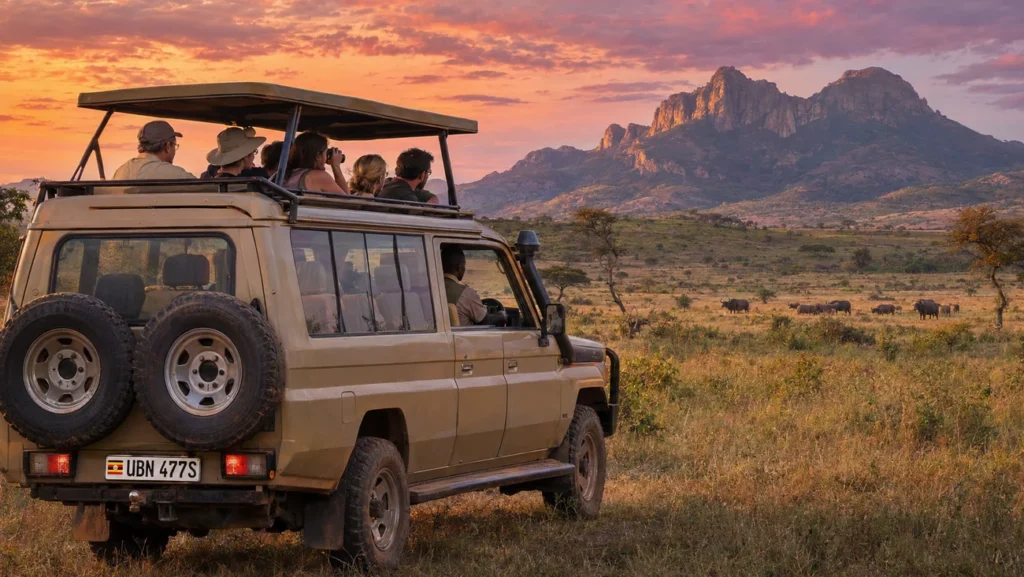
Treat a game drive as a vehicle-based activity, not a series of opportunities to walk towards animals. Your guide can explain where visitors may leave the vehicle, whether an escort is necessary and which restrictions apply at each stop.
Permission is specific to the place and circumstances. Being allowed out at a visitor facility does not mean you can step outside farther along the route. Equally, permission to stand beside the vehicle does not include permission to wander away for a photograph.
If an instruction is unclear, ask before opening the door. A useful question is: “May I get out here, and where should I stay?” This establishes both whether an exit is allowed and its boundaries.
Which stops should you distinguish?
A safari itinerary may combine wildlife drives, meal breaks, visitor facilities and separately organised activities. These should not be treated as interchangeable opportunities to leave the vehicle.
| Situation | What to assume | What to confirm |
|---|---|---|
| Animal sighting during a game drive | Stay inside the vehicle. | How to watch safely from your seat or the vehicle’s designated viewing position. |
| Roadside pause or scenic photograph | A stationary vehicle is not permission to exit. | Whether stopping and getting out are allowed at that location. |
| Visitor centre or designated picnic area | Use only the visitor space identified by your guide. | Where you may walk and whether any immediate restrictions apply. |
| Toilet or comfort stop | Ask the guide to arrange a suitable stop. | Which facilities can be used and how to reach them. |
| Separately arranged guided walk | This is a different activity from a game drive. | Authorisation, guiding arrangements, terrain and participation requirements. |
| Vehicle problem | Do not independently decide to climb out. | Follow the guide’s instructions for the particular situation. |
Why does the distinction matter?
Animals are not contained by the boundaries of a photograph. Vegetation, uneven ground and limited visibility can make it difficult for a visitor to judge what is nearby. An animal that appears distant or relaxed is not a reliable basis for deciding that walking is safe.
Nor does a popular stopping place automatically become safe for unrestricted movement. Visitor facilities and picnic areas still require awareness and compliance with local instructions. Keep children close, do not approach wildlife and return to the vehicle when asked.
The aim is not to avoid every outdoor moment. It is to enjoy each activity in the setting and format for which it has been arranged.
How should you handle common situations?
You want a better photograph
Ask your guide whether there is a permitted way to improve the view from inside the vehicle. Repositioning may not be possible or appropriate, particularly if it would disturb wildlife or obstruct other visitors.
Do not open a door, climb onto the outside of the vehicle or step down to remove a window from your photograph. Use only the viewing positions your guide identifies as suitable. Missing a particular angle is preferable to creating an unsafe encounter.
You need a toilet stop
Tell your guide early rather than waiting until the need becomes urgent. Ask during the morning briefing when suitable facilities are expected, especially before a longer wildlife-viewing outing.
Do not assume that stepping behind nearby vegetation is an acceptable solution. The guide needs to assess the location and applicable rules. If you have a condition that makes regular stops important, explain that privately before the itinerary is finalised so the practical arrangements can be discussed.
You are travelling with children
Explain the vehicle rules before entering a wildlife area. Children should know that they must ask before opening a door, remain with their accompanying adult at permitted stops and follow the guide’s instructions immediately.
Tell the operator if a child needs frequent movement breaks. Those breaks should be planned around suitable locations rather than promised wherever the vehicle happens to stop.
The vehicle develops a problem
Remain calm and listen to the guide. A mechanical issue does not make the surrounding area suitable for passengers to stand outside. Whether to stay seated or move elsewhere depends on the circumstances, so avoid making an independent decision or encouraging others to get out.
What should you ask before booking?
If spending time on foot matters to you, make that clear when discussing your safari. A game drive is not a substitute for a walking activity, and a free afternoon does not mean visitors can explore a wildlife area independently.
- Ask which outings are vehicle-based: distinguish game drives from forest treks, boat trips and other activities.
- Identify planned breaks: ask where meals, toilet stops and opportunities to stretch are intended to take place.
- Request walking options separately: confirm whether an authorised guided activity is suitable for your route and interests.
- Discuss access needs: explain any difficulty with vehicle steps, standing or walking so arrangements can be checked.
- Leave room for changes: understand that a planned stop may need to change following local instructions or conditions.
For wildlife drives in destinations such as Queen Elizabeth National Park or Murchison Falls National Park, ask for the briefing relevant to your particular outing. Do not transfer assumptions from a previous park or a safari in another country.
Related questions travellers ask
Can I stand beside the vehicle if no animals are visible?
Not without permission. An apparently empty view does not establish that the area is clear or that leaving the vehicle is allowed. Ask your guide and remain inside unless an exit is explicitly approved.
Can we stop for a picnic anywhere scenic?
No. Ask for a suitable, permitted meal stop rather than choosing a place solely for its view. Follow instructions about where to sit, keep food secure and take away your rubbish. Never use food to attract wildlife.
Does booking a private safari give us more freedom to walk?
A private arrangement does not override park rules or make an unsuitable location safe. Discuss your interest in walking before booking so that appropriate activities can be considered separately from game drives.
Can I follow other visitors who have already stepped outside?
No. Other visitors may have different instructions, be participating in an organised activity or be acting against the rules. Follow your own guide’s briefing rather than treating another person’s behaviour as permission.
Plan outdoor breaks as part of your safari
The most useful approach is to discuss breaks and walking interests before travel, then follow the briefing at each location. This avoids relying on spontaneous roadside exits for comfort, photography or exercise.
When enquiring with Pillars of Africa Safaris, mention whether you prefer primarily vehicle-based wildlife viewing or would also like guided time on foot. Share any comfort or access requirements so suitable stops and activities can be considered for your Uganda itinerary.